The AI Wire · September 2026
Industry Dispatch
Your Partner In Scalable Solutions For A Smarter Tomorrow

Another month, another reshuffling of the AI landscape. This month's been busier than most.
Below you'll find our usual two-part rundown: first, the industry-wide developments worth knowing about, then a look at what we've been building and shipping on our end. Let's get into it.
📊 Show Me the ROI, or Show Yourself the Door
The free-spending era of enterprise AI is officially over. Deloitte's latest State of AI in the Enterprise research found that only around a quarter of organizations have moved 40% or more of their AI experiments into production, and Forrester now expects enterprises to defer roughly a quarter of their planned AI spend into 2027 as financial rigor slows rollouts and kills proof-of-concepts that can't show a path to value.
The reasoning behind the crackdown is blunt: with fewer than a third of decision-makers able to connect their AI initiatives to actual financial growth, CEOs are now leaning on their CFOs to sign off based on proof, not promise.
It's not that budgets are shrinking, exactly. As one Salesforce executive put it this week, the goal isn't to throw more AI at everything; it's to match the right level of intelligence to the right job, paired with the governance and visibility leadership teams now expect.
Inside engineering specifically, spending is being tracked with much more precision than before. Finance teams are now attributing AI costs by department, by tool, and increasingly by measurable output such as tickets closed, pull requests shipped, and releases pushed, rather than treating adoption itself as a win.
Bottom line for engineering leaders: tools that make outages rarer and releases faster are the ones surviving the next budget cycle. Everything else is getting a much harder look.
📱 Meta's Muse Just Redefined What "Assistant" Means
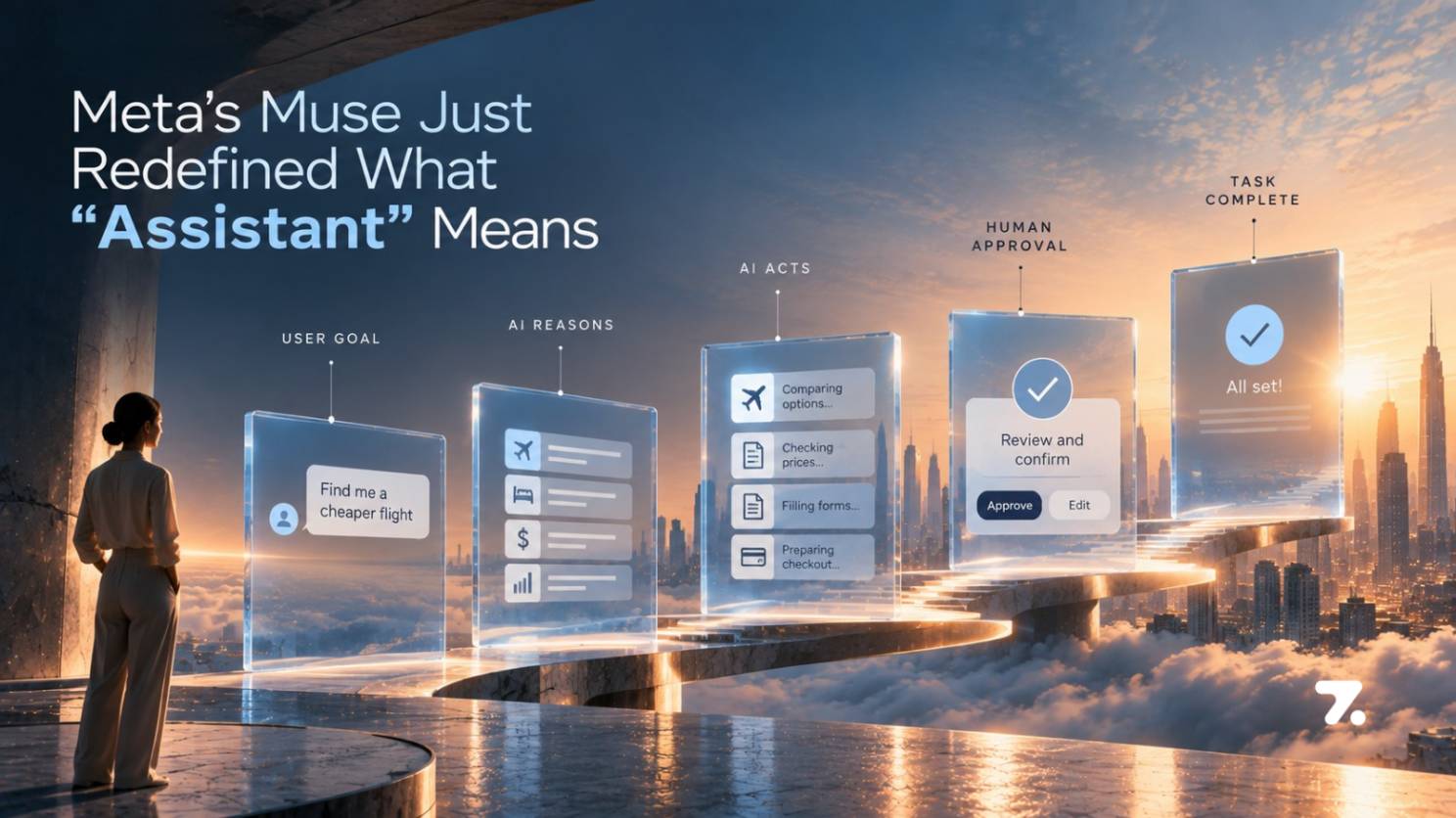
Consumer AI crossed a real threshold with Meta's Muse, an app built to do things, not just chat about them. Instead of handing you a list of links, Muse takes a goal ("find me a cheaper flight," "track this price," "clear my inbox") and runs with it: comparing options, filling out forms, and even completing checkouts with single-use virtual cards, all in the background while you go about your day.
A Few Things Stand Out
It doesn't need you glued to a chat window: Muse keeps working after you close the app, surfacing only when something's done or needs your sign-off.
High-stakes actions still need a human nod: Sending an email, booking something, spending money: Muse pauses for explicit approval, striking a sensible balance between autonomy and control.
🔐 The Trust Problem Nobody's Solved Yet

As agents get write access to production pipelines, a new question looms:
Google DeepMind's answer is a double-blind, cryptographically sealed evaluation framework that lets models get tested in complete isolation. Meanwhile, Mistral's open-weight Shieldstral is giving enterprises a local moderation layer to vet changes before they ever touch a live pipeline.
⚙️ The Frontier Is Getting Less Chatty, More Operational
The newest wave of frontier models isn't optimized for conversation; it's optimized for doing the job.
- OpenAI's Astra (part of the GPT-6 line) is built to execute tasks directly across cloud and desktop environments.
- Google rolled out Gemini 3.7 Flash alongside dedicated cybersecurity tooling that can scan an entire codebase and flag serious vulnerabilities in under two hours.
🏗️ The Infrastructure Land Grab Is Real
The hardware and platform layer is consolidating fast:
Nvidia confirmed a $12.9B acquisition of Hugging Face, pulling one of the most-used open-source AI hubs into its orbit.
Anthropic locked down over $70B in compute commitments.
OpenAI unveiled its own custom inference silicon.
TL;DR: everyone's betting that agentic workloads are about to get a lot bigger, a lot more continuous, and a lot more compute-hungry.
🧪 From the Lab: What We've Been Building
Now, onto our own corner of the AI world. Here's a look at what we've been building, testing, and putting in front of real workflows this month.
Product Spotlight
1Introducing CR Agentic AI: Risk Scoring That Can Survive an Audit
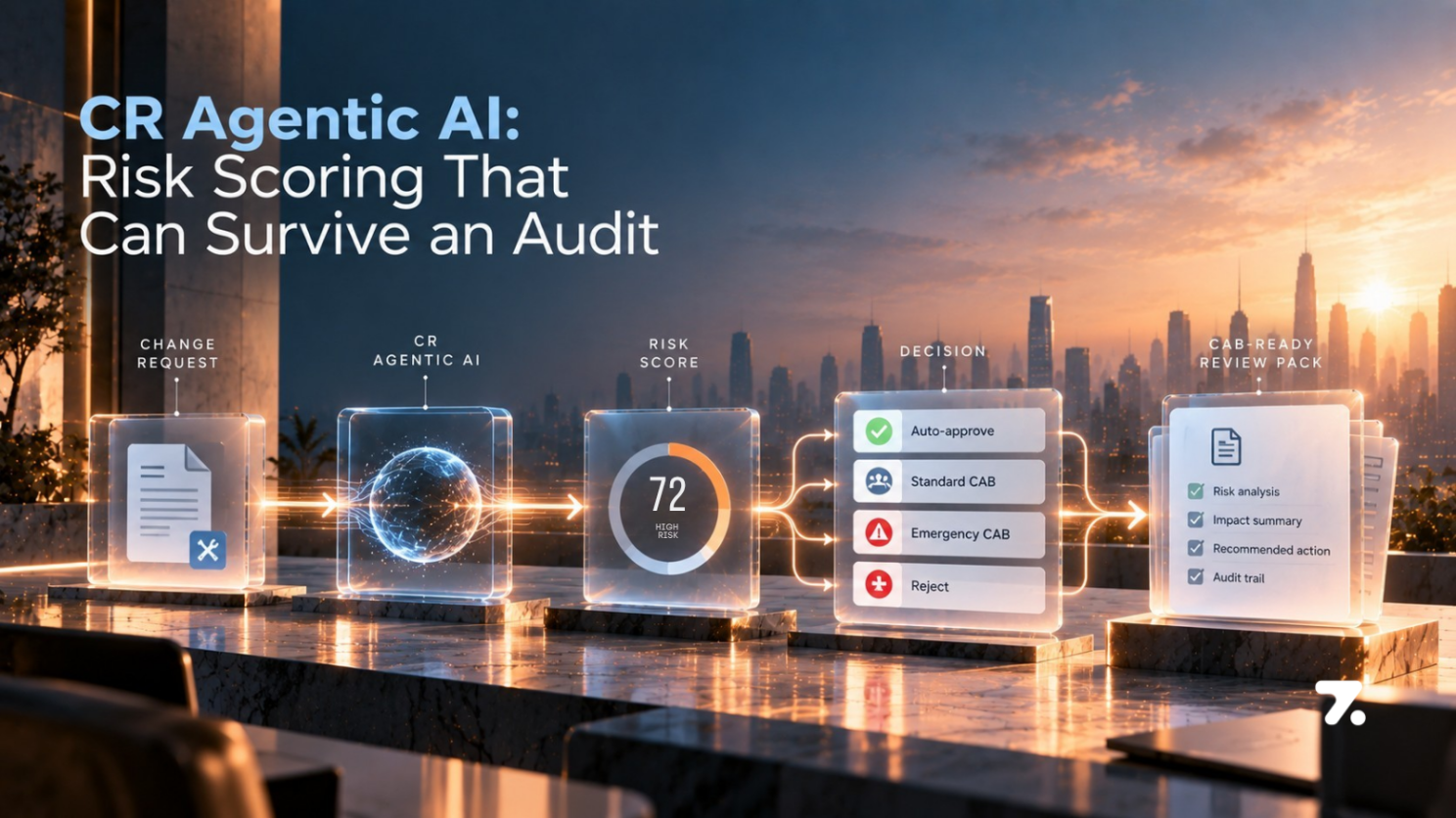
Change risk assessment has always been a bit of a trust exercise. A requester marks their own change "low risk," a CAB spends half its meeting re-reading a plan it's seeing for the first time, and somewhere in that gap, genuinely risky changes slip through while trivial ones sit queued behind them.
CR Agentic AI was built to close that gap, and to do it in a way that holds up when someone asks, a year later:
Here's the short version: it plugs directly into ServiceNow, reads a Change Request, and returns:
- A defensible risk score
- A clear verdict: auto-approve, route to standard CAB, route to emergency CAB, or reject
- A CAB-ready review pack, written straight back onto the record
The next phase of AI won't be defined by what models can say. It will be defined by what businesses can safely put them to work on.
Let's Keep the Momentum Going!
- Stay in the loop: subscribe to The AI Wire on LinkedIn for monthly AI briefings
- Spread the knowledge: forward this to a colleague who'd find it valuable
- Discover more: explore our solutions at technozis.ai