The AI Wire · November 2026
AI World News
Your Partner In Scalable Solutions For A Smarter Tomorrow
Welcome to this month's edition of The AI Wire, your monthly briefing on the AI stories that matter and what we've been building in the lab at Technozis.
Let's get into it.
💰 The $4.9 Trillion AI Reality Check: Capex, Revenue, and the Inference Paradox
A stark warning from a recent Gartner report has sent shockwaves through the tech sector, projecting that over $3.5 trillion in AI infrastructure spending could face impairment and capital write-downs by 2030. At the heart of the crisis is a massive financial mismatch: while AI infrastructure providers are projected to spend nearly $1 trillion in 2026 alone and $6 trillion more between 2027 and 2030, actual enterprise and consumer AI revenue is forecasted to max out at just $3.6 trillion over that period.
While hardware investors struggle under heavy debt, advancements in optimization and open-weight models have sent raw token costs plummeting by 50% to 90%. While this token deflation compresses profit margins for infrastructure giants, it is creating a massive win for software developers and the broader open-source ecosystem.

The Silver Lining: Why Token Deflation & Open-Source AI Benefit Everyone
While data center operators grapple with falling token margins, this hyper-efficiency is a game-changer for developers:
Unlocking Complex Agentic Workflows: Falling prices mean engineering teams can finally afford to build sophisticated, multi-step agentic architectures without breaking the bank on inference costs.
The Rise of Open-Source Dominance: As raw compute costs drop, open-weight models are leveling the playing field, allowing startups and enterprises alike to run powerful, customizable models locally or on-premise without relying on costly closed-source monopolies.
Democratizing Innovation: Cheaper tokens and accessible open-source frameworks lower the barrier to entry, ensuring that the next wave of AI-driven tools and automation can be built, tested, and deployed by anyone.
🎮 Google DeepMind's Minecraft Milestone: Multi-Agent Autonomy in Sandbox Worlds

The boundaries of autonomous AI planning were pushed significantly further this month as Google DeepMind successfully deployed a team of four autonomous AI agents powered by the Gemini 4 Argon architecture to beat Minecraft's final boss (the Ender Dragon) from absolute scratch in a randomly generated world in just over 27 hours.
Moving far beyond short-form chat queries, the agents actively collaborated by dividing labor over text chat, sharing notes, and independently writing 2,783 of their own JavaScript programs to navigate the environment.
Why This Matters
Mastering Long-Term Planning: This successful run proves that modern AI agents can maintain multi-day objectives, track complex sub-tasks, and correct their own coding errors dynamically without human intervention.
Resilience in Unpredictable Environments: Because the world was randomly generated, the agents could not rely on memorized walkthroughs or pre-computed patterns. They built internal mental models, recovered from repeated failures (dying 605 times across the run), and improvised clever physical solutions.
🤖 Physical AI in Action: Microduck Steals the Stage at GTC Berlin

At the NVIDIA GTC Berlin keynote, CEO Jensen Huang showcased Microduck, an affordable, open-source bipedal robot by Pollen Robotics (Hugging Face), to demonstrate the fast-evolving world of "physical AI."
Trained en masse inside virtual digital twin environments using NVIDIA Isaac Lab and Isaac Sim, thousands of virtual ducks perfected movement policies in cloud simulations before deploying directly onto the physical hardware. On stage, a flock of real-world Microducks responded to live voice commands to sit, stand, and "take a nap," highlighting how high-speed cloud simulation and edge intelligence are converging to make robotics research dramatically faster and more accessible.
🧪 From the Lab: What We've Been Building
Product Spotlight
1PayMatch: Automating Accounts Payable
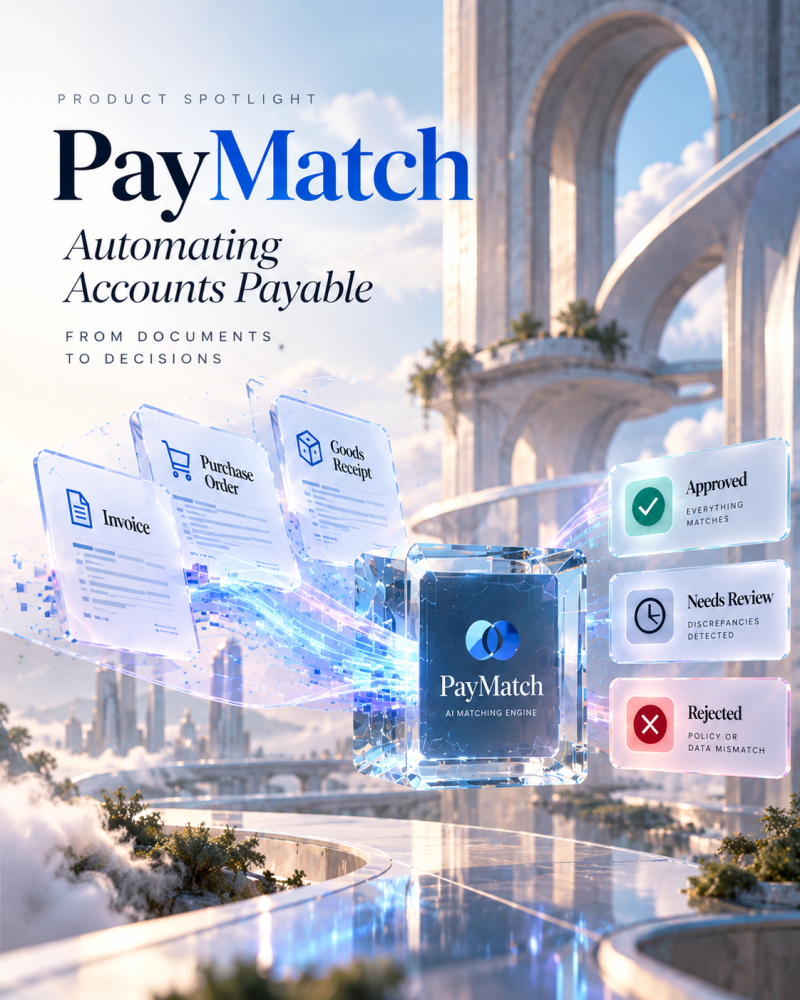
Manual invoice matching is one of the quietest bottlenecks in finance and construction operations, often forcing teams to spend hours cross-referencing PDFs line-by-line against separate spreadsheets, purchase orders (POs), and goods-receipt notes (GRNs).
To close this gap, PayMatch has been developed as an intelligent 3-way matching and accounts-payable workflow engine. Rather than relying on rigid, template-based OCR parsers or manual visual checks, the platform allows users to simply drag and drop vendor PDF invoices into a centralized web portal.
- Automatically extracts invoice details and matches them against purchase orders and goods-receipt records
- Checks vendor names, amounts, descriptions, and receipt validity
- Every document receives one of three outcomes: Approved, Needs Review, or Rejected
- Standardized checks and audit trails reduce errors, prevent duplicate payments, and accelerate invoice processing
2CR Agentic AI: Audit-Proof Change Risk Scoring in ServiceNow

Change risk assessment often relies on self-reported ratings, leaving Change Advisory Boards (CABs) overwhelmed and critical risks overlooked. CR Agentic AI addresses this with fast, defensible risk scoring and transparent decision-making. For the foundation behind this solution, read our previous edition of The AI Wire.
CR Agentic AI was engineered to generate risk scores that aren't just fast but fully defensible when an auditor asks, a year later:
Plugging directly into ServiceNow, the system evaluates Change Requests and returns a clear, actionable verdict (auto-approve, route to standard CAB, route to emergency CAB, or reject) alongside a CAB-ready review pack written straight onto the record.
What's New in This Updated Iteration
Building on our initial release, this latest version introduces key architectural and governance updates designed to make risk scoring completely deterministic and audit-proof:
Independent, Deterministic Scoring Engine: Language models no longer directly dictate the final risk score. The underlying mathematical calculation is run independently, ensuring scores remain completely reproducible and consistent.
Policy-Based Escalation Layers: Hard safety policies (veto and minimum-band rules) operate independently from the weighted risk calculations, ensuring policy overrides automatically take precedence without altering the underlying raw arithmetic.
Two-Iteration Arbitration Loop: If specialist assessments clash, an automated arbitrator executes a strictly bounded review loop, allowing at most one specialist re-execution, to resolve discrepancies while preventing infinite loops.
Cryptographic SHA-256 Audit Digest: Every score, policy override, and review is logged back to ServiceNow. A SHA-256 digest of requester-editable fields instantly proves whether inputs were modified or an assessment was simply re-run on unchanged data.
Let's Keep the Momentum Going!
- Stay in the loop: subscribe to The AI Wire on LinkedIn for monthly AI briefings
- Spread the knowledge: forward this to a colleague who'd find it valuable
- Discover more: explore our solutions at technozis.ai
Sources & Further Reading
Gartner: Over $3.5 trillion of AI infrastructure spending could be exposed to impairment by 2030
Tom's Hardware: Four Gemini 4 agents beat Minecraft in 27 hours
Times of India: Gemini 4 Argon agents beat Minecraft from scratch